Last updated: 14 October 2025
Functional Training is one of those terms that now means almost everything and therefore almost nothing. On Instagram you’ll see people balancing on wobbly half-spheres, a studio nearby runs a kettlebell class called “functional”, and someone claims traditional strength training is “non-functional.” Let’s clear this up.
What the term originally means
Functional Training comes from rehabilitation. The core idea: instead of training a single muscle, you train a movement — as close as possible to what the body actually needs to do in daily life or sport. Not “bend the biceps,” but “lift something heavy from the floor and carry it.”
This leads to a simple criterion: an exercise is functional if it transfers to your actual life. For a care worker who lifts people every day, that’s different than for an accountant with a gardening hobby. There’s no list of functional exercises — there are only functional exercises for someone.
The three misunderstandings
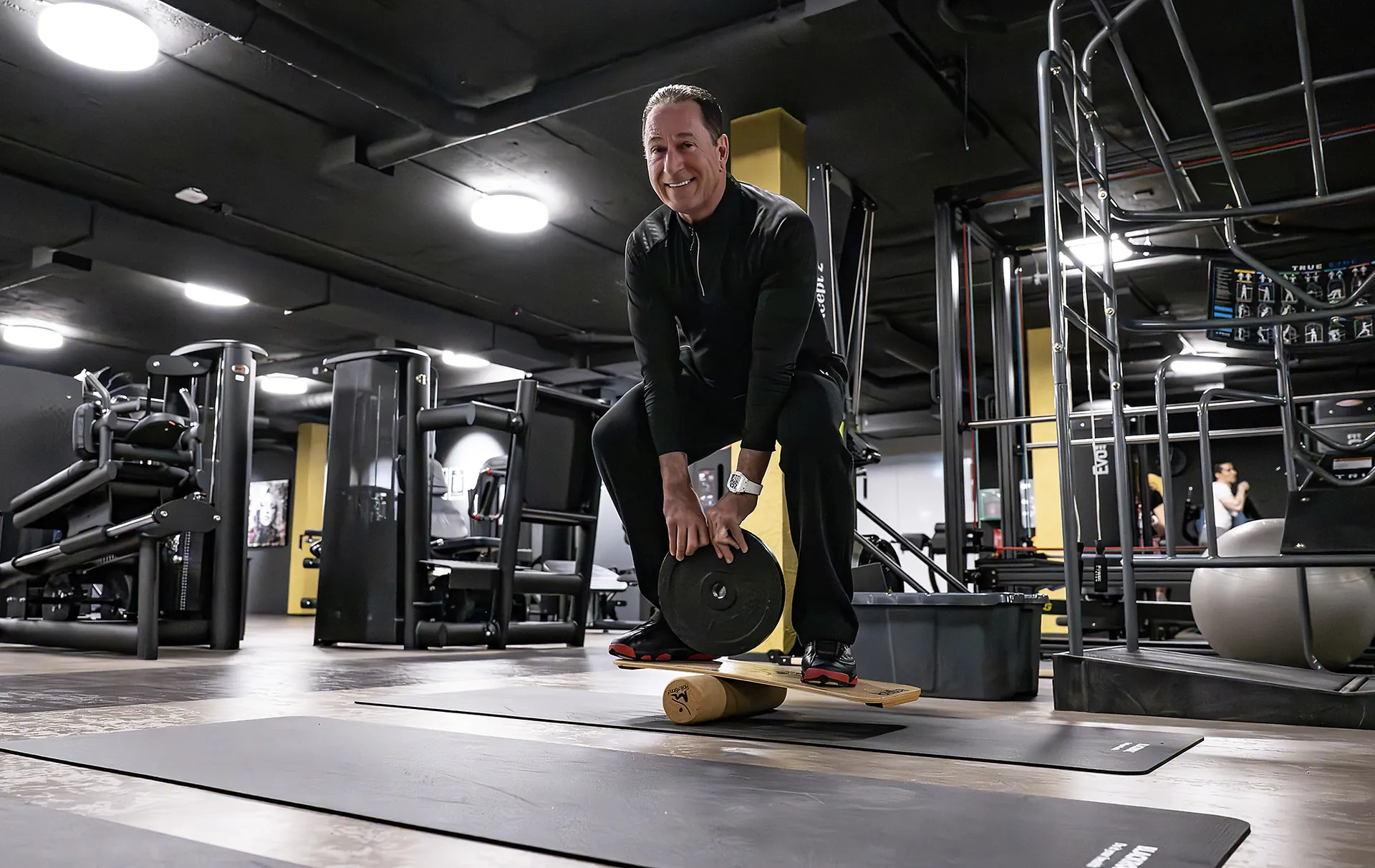
- “Functional means unstable.” Wobble boards and balance cushions have their place — especially in rehab and balance training. But instability isn’t the defining feature of functionality. A clean squat on a solid floor is highly functional.
- “Machines are non-functional.” A guided machine trains a movement safely and precisely — for beginners often a better path to functional goals than a free exercise with poor technique.
- “Functional replaces strength training.” The opposite: without basic strength, functional training often becomes just coordination work. Strength is the foundation on which transferability is built.
What functional training actually delivers
The benefits are in areas rarely measured, but felt every day:
- Core stability — the body holds its centre steady while arms and legs move. Noticeable when carrying, bending, lifting.
- Balance — with age, this may be the most important factor overall. The WHO recommends balance training explicitly from age 65 for fall prevention.[1]
- Movement quality — joints move through their full range, not just the limited motion required by daily routines.
- Coordination over isolation — multiple muscle groups learn to work together. Exactly what you need outside the studio.
Who benefits most
Based on daily client work, we’ve seen four groups that gain significantly more than average:
- People with sedentary jobs, whose movement repertoire has narrowed over years.
- Older trainees, where balance and daily safety are top priorities — here, transfer is most immediate and tangible.
- Returners after injury, who need to rebuild movement patterns, not just muscle mass.
- Active athletes with specific demands — rotation in golf, single-leg stability when running.
How to combine it sensibly
The most practical structure for most: basic strength as foundation, functional elements as supplement. So two strength sessions per week focusing on large movements — squat, pull, press, hip extension — and 10 to 15 minutes for core, balance, and mobility within or after each session.
Starting with pure functional training without a strength base often hits a wall quickly: coordination improves, but endurance doesn’t. The reverse works better.
Frequently asked questions
Do I need special equipment?
No. Your own body, a few dumbbells, and some space are enough for most. Equipment expands options but isn’t required.
Is functional training suitable for beginners?
Yes, in measured doses — with focus on technique and a stable surface. Wobble mats don’t belong in the first week.
How often?
As a supplement to two strength sessions, 10 to 15 minutes per session suffice. As a standalone session, once to twice a week.
Try it in Lucerne
At laSuite on Zürichstrasse 33, you’ll find both guided strength machines and open space with equipment for functional training — the combination that works best for most people. Get a feel for it at The Studio.
If you’re just starting out, read more on How often should you train? and — if your back is involved — Strengthen your back, don’t rest it. Pricing: Prices. Questions? Contact us.
About the author
The team at laSuite Fitnessclub, Lucerne. We support beginners, returners, and ambitious athletes at Zürichstrasse 33 — 24/7, 365 days a year. Strength training, prevention, and physiotherapy under one roof. Questions? Send us a message.
Sources
- World Health Organization: Physical activity – Fact sheet (includes balance training from age 65 for fall prevention).
- Federal Office of Sport BASPO / HEPA Switzerland Network: Movement recommendations for Switzerland.
Note: This article provides general information and does not substitute for individual medical advice. If you have existing symptoms or pre-existing conditions, please consult a doctor before starting training.
Book Your Trial Session
Come by and experience LaSuite – no commitment, fully guided.
Book Trial Session