“How much muscle mass can a woman realistically build?” – we hear this question at Zurichstrasse almost every week. Usually, it’s driven by one of two worries: that progress is too slow, or that it’s too fast and you’ll suddenly end up looking “too muscular”. Both concerns can be put to rest with some numbers.
How much muscle mass is realistic?
The honest answer: less than ads make out — and more than most women think possible. As a beginner, gaining between 0.5 and 1.5 kilograms of muscle mass in twelve weeks is a realistic target when training and nutrition are on point. After the first year, progress slows significantly, as your body has already made the easy adaptations.
That sounds small. On the scale, it is. But in the mirror and when lifting weights, it makes a big difference: one extra kilogram of muscle reshapes your silhouette noticeably, because muscle tissue is denser than fat and takes up less space.
It’s important to distinguish between strength and mass. In the first few weeks, you’ll get noticeably stronger without actually building much muscle — that’s your nervous system learning to fire existing muscle fibres more effectively. The visible bulk comes later.
Why you won’t suddenly become “too muscular”
This worry is the most common — and completely unfounded. On average, women have only a fraction of the testosterone levels found in men, and testosterone is one of the key drivers of muscle growth. You don’t accidentally end up with a bulky physique after a few months of weight training.
What’s interesting is the flip side of the same research: Women gain strength relative to their starting point at a similar rate to men. Absolute numbers differ, but trainability is almost identical. There’s no reason to stick to pink dumbbells and “women’s training”.
What really matters in your training
Three things make the difference — and none of them is a specific machine:
- Progressive overload. The weight needs to increase over weeks. If you’re lifting the same weight in month three as in week one, your body has no reason to adapt.
- Sufficient stimulus per muscle group. Two to three sessions per week, with multiple sets per group, form the reliable foundation. The WHO recommends strength training on at least two days per week as a health minimum — for muscle growth, a bit more is perfectly fine.
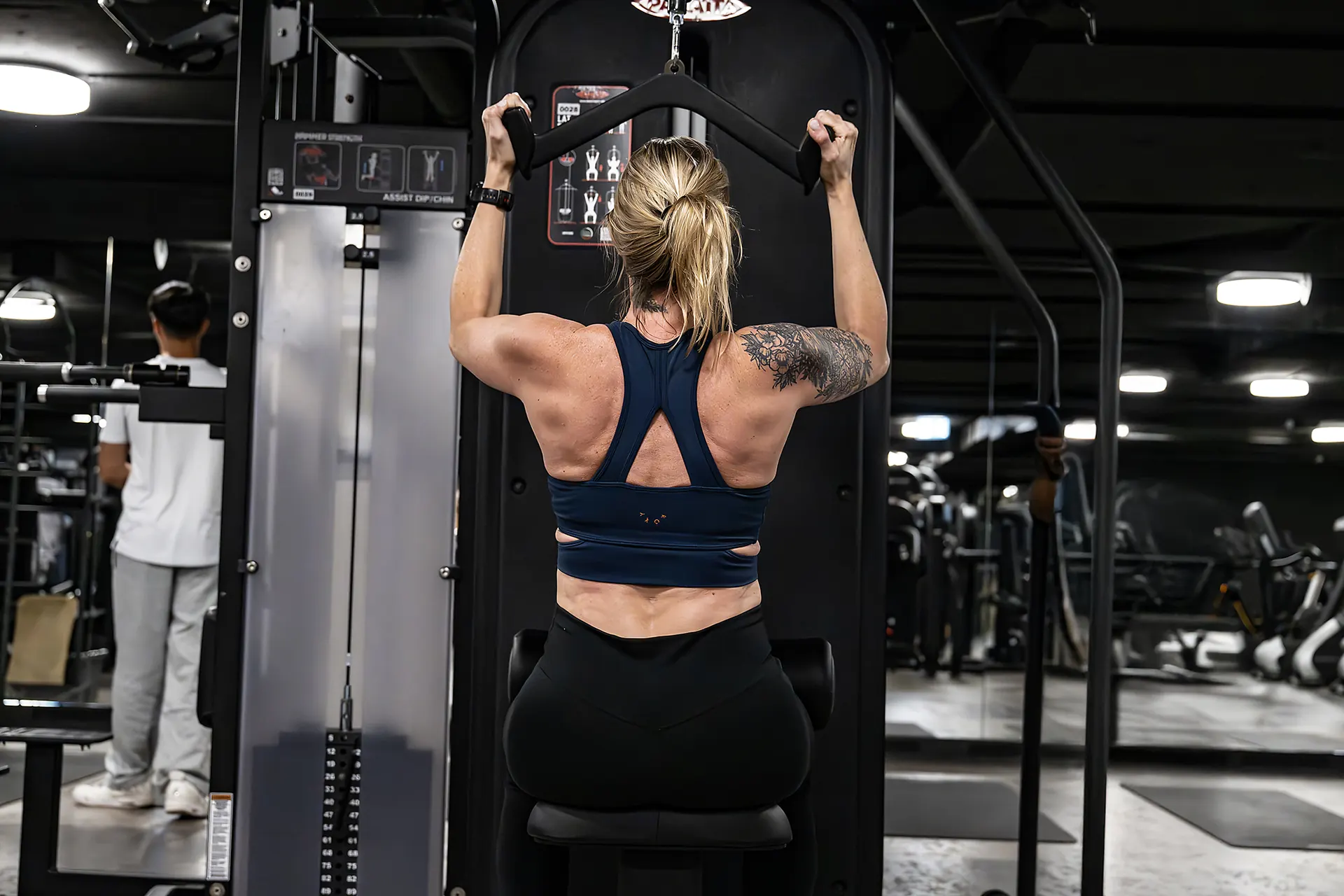
- Start with compound movements. Squats, deadlifts, rows, lat pulldowns, shoulder presses. They work more muscle mass per unit of time. Isolation exercises are useful for finishing touches, not replacements.
The rep range is less important than people claim: muscle growth works from about 6 to 20 reps, as long as you’re taking sets close to fatigue. What matters more than hitting a perfect number is maintaining clean form.
Protein: the underrated lever
No building material, no growth. Research here is unusually clear: around 1.6 grams of protein per kilogram of body weight per day unlocks most of the potential gains; beyond that, benefits taper off sharply. For a woman weighing 65 kg, that’s roughly 105 grams daily — spread across meals, not consumed in one sitting.
The second point is less comfortable: muscle growth usually needs a small energy surplus. At the same time, losing fat and building muscle significantly is only consistently possible in beginners and returnees. If you want both, pick which comes first.
Why the scale gives the wrong answer
If you’re simultaneously losing fat and building muscle, the scale won’t budge — and you think nothing’s happening. That’s precisely when most quit, even though the changes are already under way.
That’s why we measure body composition, not body weight. A 3D Body Scan shows how your muscle and fat percentages are shifting. Two assessments spaced twelve weeks apart tell you far more than daily weighing — and save a lot of frustration.
Frequently asked questions
How long until you start to see results?
You’ll notice strength gains within two to four weeks. Visible changes usually take eight to twelve weeks — provided you keep progressively increasing the load.
Should I adjust my training to my cycle?
For most, listening to how you feel and reducing volume rather than technique on low-energy days is enough. For more detail, see Strength training for women over 30.
Are machines enough, or do I need free weights?
Both work for muscle growth. Machines are often more comfortable for beginners, as the movement is guided; free weights also train stability. A sensible mix beats either extreme.
What if I only have time for twice a week?
Then twice a week is the right answer. Two consistent sessions over a year beat four sessions that fizzle out after six weeks — see Staying consistent.
Where to start
At laSuite Fitnessclub, we create a personalised training plan based on your lifestyle — not the demands of a competition athlete. Unsure how your first few weeks should look? How often should you train? gives you a solid starting point; for general guidance, check Getting started.
Take a look at the space in The Studio, and find all the details on Prices. Got questions about your situation? Get in touch.
About the author
The team at laSuite Fitnessclub, Lucerne. We support beginners, returners, and ambitious athletes at Zurichstrasse 33 — 24/7, 365 days a year. Strength training, prevention, and physiotherapy under one roof. Got questions? Message us.
References
- World Health Organization: Physical activity – Fact sheet (strength training on ≥2 days/week).
- Morton RW et al. (2018), British Journal of Sports Medicine: Meta-analysis on protein intake and muscle growth (plateau around 1.6 g/kg/day).
- Roberts BM, Nuckols G, Krieger JW (2020), Journal of Strength and Conditioning Research: Sex Differences in Resistance Training — systematic review and meta-analysis.
Note: This article provides general information and does not replace individual medical or nutritional advice. Consult a healthcare professional before starting training if you have existing conditions, are pregnant, or have ongoing symptoms.
Book Your Trial Session
Come by and experience LaSuite – no commitment, fully guided.
Book Trial Session